Title case capitalizes the important words in a title and leaves a short list of small words lowercase. The trouble is that AP, APA and Chicago do not agree on exactly which small words belong on that list.
This guide covers where the styles agree, where they split, and how sentence case differs. Each rule is quoted from the guide’s own pages, and where a guide sits behind a subscription, we say so instead of guessing.
Key Takeaways
- Capitalize the first word and every verb, even short ones such as Is and Be.
- The biggest split is prepositions: AP and APA capitalize prepositions of four letters or more, while Chicago’s 18th edition (2024) capitalizes only those of five or more, so it writes A Room with a View.
- Chicago capitalizes the last word of a title whatever its part of speech, and APA capitalizes the second part of a hyphenated major word, as in Self‑Report.
- Sentence case capitalizes the first word, proper nouns and little else. APA requires it for titles in a reference list, even when the original used title case.
- A converter with a fixed word list does most of the work, but check the last word, hyphenated words, acronyms and four-letter prepositions by hand.
What Is Title Case?
Title case is a capitalization style in which major words start with a capital letter and most minor words stay lowercase. APA Style defines it in one line: “In title case, major words are capitalized, and most minor words are lowercase.”
What counts as major is where the styles differ, and APA’s definition is the clearest start: “Nouns, verbs (including linking verbs), adjectives, adverbs, pronouns, and all words of four letters or more are considered major words.”
Which Words Do You Capitalize in Title Case?
Capitalize the first word and every noun, verb, adjective, adverb and pronoun, and keep articles, short conjunctions and short prepositions lowercase. APA and Chicago both state these rules, and the verb rule covers AP too.
- The first word, always. APA says to capitalize “the first word of the title or heading, even if it is a minor word,” so The and A get a capital when they open a title.
- Every verb, however short. Chicago’s editors write that the major styles “all specify an initial capital for verbs, regardless of length,” which is why Life Is Beautiful capitalizes Is (CMOS Shop Talk).
- The first word after a colon. APA lists “the first word after a colon, em dash, or end punctuation in a heading,” and Chicago answers the same question with “So cap the word after the colon” (Chicago Q&A).
- Small words in the middle stay lowercase. APA says to “Lowercase only minor words that are three letters or fewer in a title or heading.” Chicago’s rule names five coordinating conjunctions it lowercases: and, but, for, or and nor (Chicago Q&A).
Chicago adds one rule that APA’s title case page does not mention: “The last word is capitalized in a Chicago-style title, regardless of syntax” (Chicago Q&A). So What Is It Good For? capitalizes For.
What Are the Differences Between AP, APA and Chicago?
The main difference is where each style draws the line on prepositions. Chicago’s editors put it plainly: “AP and APA capitalize prepositions of four letters or more in a title, whereas for Chicago it’s now five or more.”
That “now” matters. Chicago lowercased prepositions of any length until its 18th edition, published in 2024, which changed the rule: “In titles of works, prepositions of five or more letters will now be capitalized (A Room with a View but Much Ado About Nothing)” (CMOS Shop Talk). If you learned Chicago before 2024, Much Ado about Nothing is the old style.
The AP Stylebook is subscription-only, so the AP column shows only what Chicago’s editors state about AP. “Not verified” means we could not confirm the rule from a source we could read, not that AP lacks it.
| Word or position | AP | APA | Chicago (18th ed.) |
|---|---|---|---|
| Verbs, even short ones (Is, Be) | Capitalize | Capitalize | Capitalize |
| Four-letter prepositions (With, From, Into) | Capitalize | Capitalize | Lowercase |
| Prepositions of five letters or more (About, Between) | Capitalize | Capitalize | Capitalize |
| Short prepositions (in, of, on, to) | Not verified | Lowercase | Lowercase |
| and, but, for, or, nor | Not verified | Lowercase | Lowercase |
| as | Not verified | Lowercase | Lowercase |
| Last word | Not verified | Not stated | Capitalize |
| First word after a colon | Not verified | Capitalize | Capitalize |
| Second part of a hyphenated word | Not verified | Capitalize if it is a major word | Capitalize, including after a prefix |
| to before a verb (Born to Run) | Not verified | Not stated | Lowercase |
The Chicago cells come from its editors’ answers: “as” stays lowercase “in any grammatical function” (faq0113), and “starting with the 18th edition, CMOS recommends capitalizing the second element in a hyphenated compound formed with a prefix” (faq0094). The “to” in an infinitive, as in Born to Run, stays lowercase in the middle of a title (faq0092).
What Is the Difference Between Title Case and Sentence Case?
Sentence case capitalizes only the first word, proper nouns and a few other words, so a title reads like an ordinary sentence. APA’s rule is short: “In sentence case, lowercase most words in a title or heading” (APA Style).
- Title case:
How to Choose a Web Host for Your Small Business - Sentence case:
How to choose a web host for your small business
APA uses both, for different jobs. Title case is for “all headings within a work” and for titles mentioned in your text, while sentence case is for “titles of articles, books, reports, webpages, and other works in reference list entries, even if title case was used in the original work.”
Which Style Should Your Website Headings Follow?
Follow the style your client, school or publisher names, and if nobody names one, pick one and apply it to every heading on the site.
Chicago’s editors allow either approach for subheads: sentence case “is also an option for subheads, provided it’s consistently applied across a document.” Whichever you choose, write it down, including which style guide sets the preposition rule, so every writer on the site capitalizes With the same way.
Can a Case Converter Apply Title Case Rules?
A case converter with a fixed word list can do most of the work, but it cannot follow rules that depend on grammar, such as Chicago’s “than” rule or “up” used as an adverb.
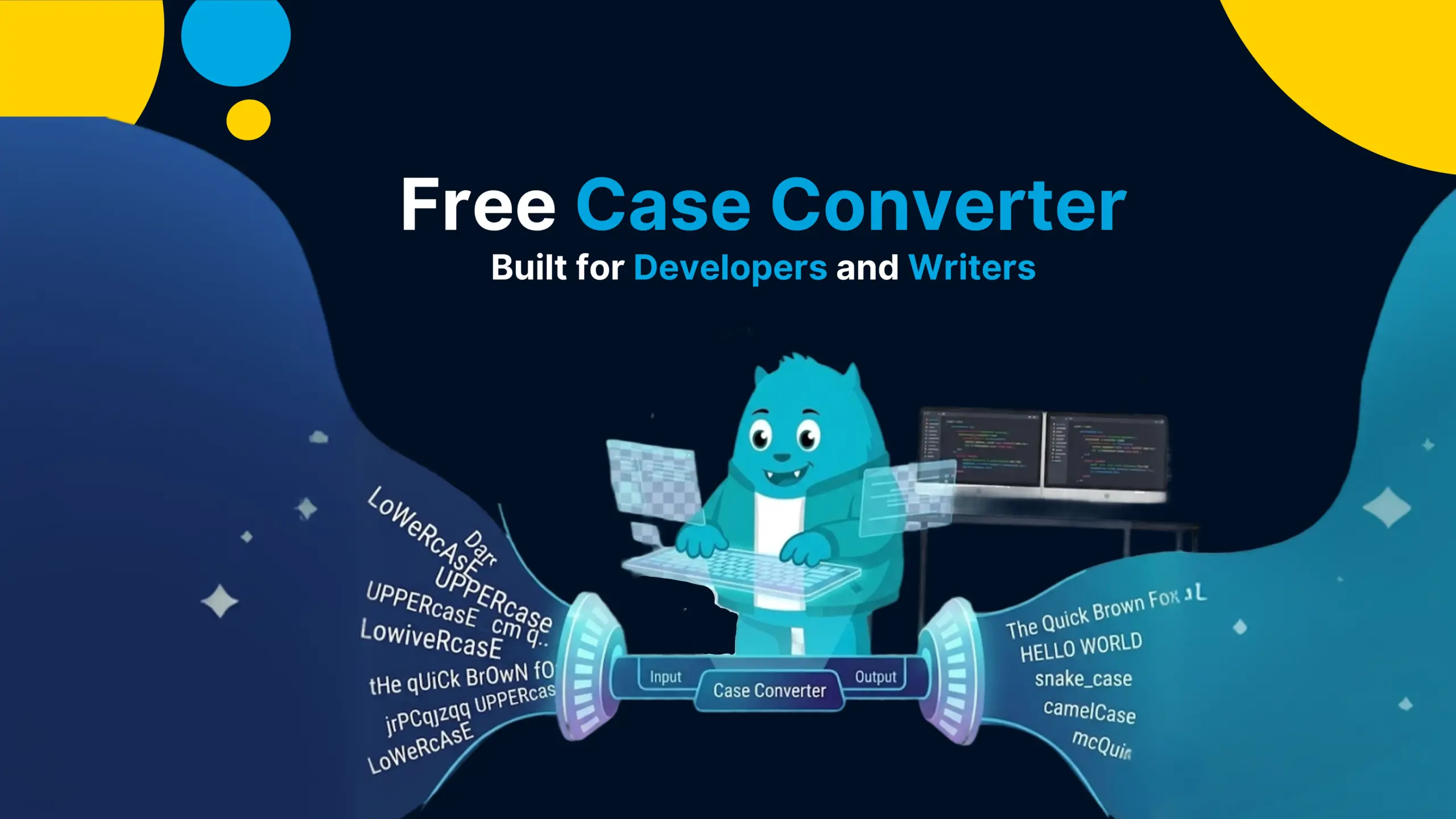
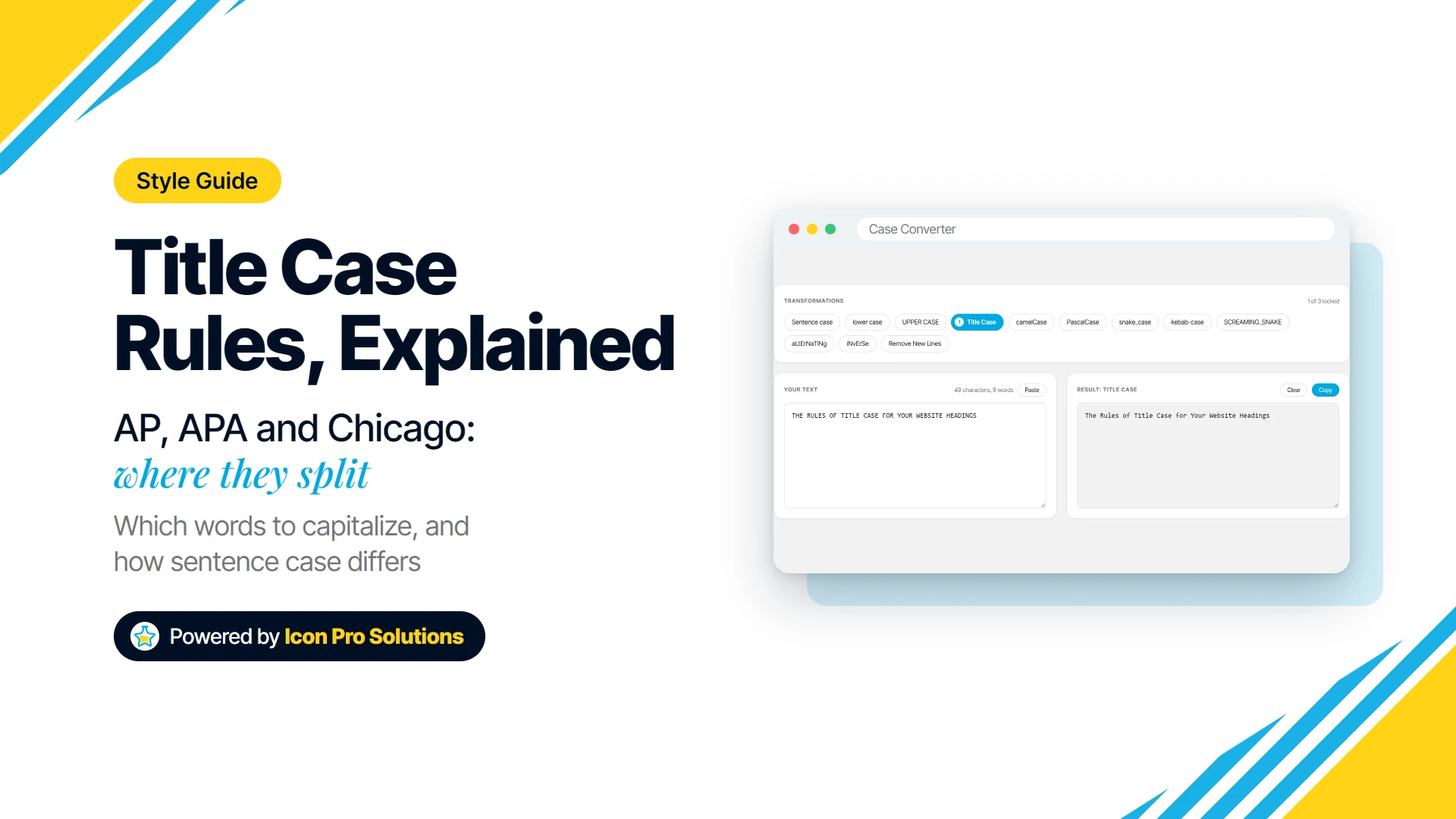
Our free Case Converter has one Title Case option, not separate AP, APA or Chicago modes. It capitalizes the first word and keeps 15 small words lowercase everywhere else: a, an, the, and, but, or, for, nor, on, at, to, by, in, of and up. Every other word gets a capital, so four-letter prepositions come out as With and From, which matches AP and APA but not Chicago.
Paste a draft headline, lock Title Case, and copy the result; it runs in your browser and your text is not sent anywhere. Then check these by hand:
- The last word. A listed word at the end stays lowercase, so
what are you waiting forbecomesWhat Are You Waiting for, where Chicago would write For. - Hyphenated words. Only the first part is capitalized, giving
Self-reportwhere APA wants Self‑Report. - Acronyms and brand names. Each word is lowercased before its first letter is capitalized, so NASA comes out as
Nasaand iPhone asIphone. - as, so, yet and if. They are not on the list, so they get a capital, although APA lowercases all four and Chicago lowercases “as”.
- Words that depend on grammar. “up” is always lowercase, so
Breaking up Is Hard to Doneeds fixing: Chicago’s editors note that “Up” there “is an adverb, not a preposition.” - After a colon. A listed word after a colon stays lowercase, as in
Final Update: the End, while APA and Chicago capitalize it. - One title at a time. Only the first word in the box counts as the first word, so a second line that starts with “the” stays lowercase.
For the other eleven formats it handles, such as kebab-case for URL slugs, see the Case Converter tool page and our overview of what the case converter does.
FAQs
Is “That” Capitalized in a Title?
Yes, in Chicago style it always is, because “that” is never a preposition and is not one of the five conjunctions Chicago lowercases (faq0098). In APA it is capitalized because it has four letters.
Is “Than” Capitalized in a Title?
In Chicago style it depends on how the word works in the sentence. As a preposition it is lowercase, as in Younger than Springtime, and as a conjunction it is capitalized, as in Mnemonics That Work Are Better Than Rules That Do Not (faq0074).
Do Words in Parentheses Follow Title Case?
Yes, Chicago applies title case as if the parentheses were not there: “the punctuation marks are usually ignored when applying title case.” Its example keeps “and” lowercase in It’s the End of the World as We Know It (and I Feel Fine) (faq0105).
Can a Book Cover Ignore Title Case Rules?
Chicago says it can: its rules cover titles mentioned or cited in text, and on a cover or title page, “design takes precedence over the style for text” (faq0108). Mentioned in a paragraph or a citation, the title follows the normal rules.