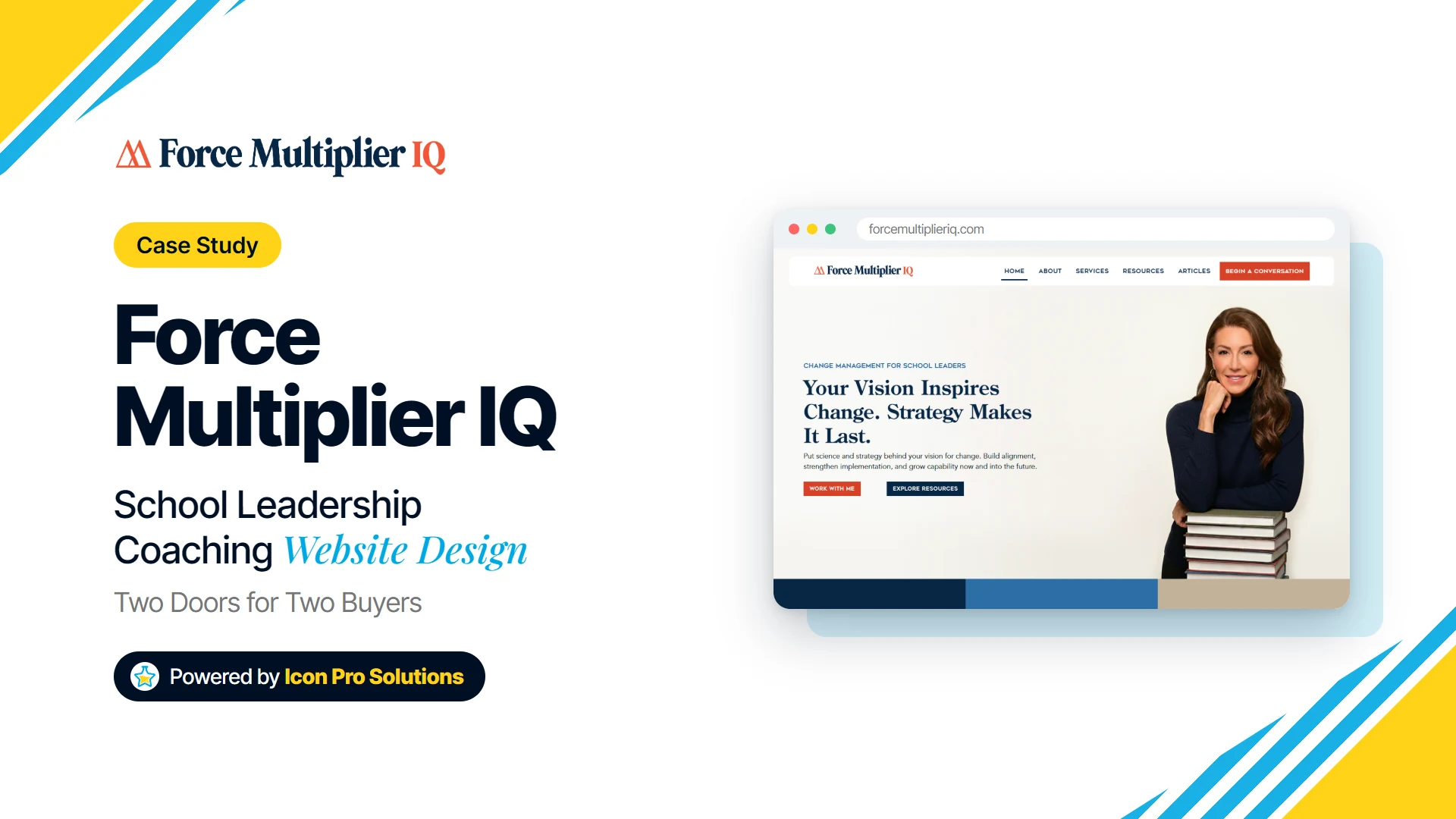
Force Multiplier IQ brings change management to schools, and its website has to persuade two very different readers at once. One is a principal or aspiring leader deciding privately whether to invest in their own growth. The other is a district office or university weighing a contract that someone will have to defend in a budget meeting.
Most coaching sites are written for the first reader and leave the second to find their own way. This case study looks at how the site we designed and built for Force Multiplier IQ gives each reader a separate door, and what that choice asks of the content behind it.
Key Takeaways
- An education consultancy often sells to an individual and to an institution, and the two need different first steps.
- A precise niche claim, change management for schools, does more work than a general promise about leadership.
- Scale figures from past work reassure an institutional buyer in a way that personal stories cannot.
- When schools buy on behalf of staff, the privacy policy becomes part of the sales conversation, especially on student data.
- Separate paths only help if both lead somewhere with real substance.
What Does Force Multiplier IQ Do?
Force Multiplier IQ translates established change management research, protocols and strategy for what the site calls the relational complexity of K-16 education. It describes its work as designed for school leaders by a school leader, and its About page is built around Anna Carello. The home page cites more than two decades across public and independent education, from districtwide work reaching 10,000 teachers and 300 principals to university partnerships preparing future school leaders.
The work is offered in two forms. School leaders are offered strategic advising and courses, while schools, districts and universities are offered team workshops and university partnerships. The privacy policy adds that the business runs online courses, programs, digital products, live sessions and a community for participants.
Why Does the Home Page Split Into Two Paths?
Because the two buyers make decisions in different ways. A principal reading alone is asking whether this person understands the pressure they are under. A district is asking whether this provider can work at scale, fit a procurement process and stand up to questions from a board.
The home page answers with two labeled panels: For School Leaders, leading to Strategic Advising & Courses, and For Schools, Districts, & Universities, leading to Team Workshops & University Partnerships. The same pair appears again on the About page, so a reader who arrives through the founder’s story still meets the choice. That repetition matters because many visitors never see the home page first.
The Trade-Off in a Split
A split asks visitors to classify themselves, and some cannot. An assistant principal who might take a course alone and might also recommend a workshop for their whole school sits across both doors. The labels work here because they name the buyer rather than the product, so a reader can choose by who is paying instead of guessing at a service name.
Why Lead With Change Science Instead of Coaching?
The headline reads “Built For Schools. Backed By Change Science.”
That line narrows the offer on purpose. Leadership coaching is a crowded category, and most of its websites make the same promises about confidence, clarity and growth. Change management is a named discipline with research behind it, and schools go through change constantly: new leadership, new curricula, restructures and mergers.
By pairing a recognized discipline with a single sector, the site gives an institutional buyer words they can put into a proposal. Change management support for a leadership team is easier to defend in a budget line than coaching. The risk is that the phrase feels abstract to an individual reader, which is why the individual path leads with advising and courses rather than theory.
What Does the Evidence Need to Carry?
On a site like this, proof has two jobs. For the district, it has to show scale: this person has worked with systems as large as ours. For the individual, it has to show that someone in a similar role found the work useful.
The site handles scale with figures from the founder’s career, the 10,000 teachers and 300 principals reached through districtwide work. It handles the personal side with testimonials signed with a first name, an initial and a town, and it places a different one on the home, About, Services and Contact pages. A reader on any of those pages meets a voice from a real school community, not a block of praise hidden on a separate page.
A Values Signal Education Buyers Notice
The home page also states that three percent of annual net profits fund professional development for classroom teachers aspiring to lead. For a buyer spending public or tuition money, this is not decoration. It tells them where part of their payment goes, and it ties the business to the pipeline of future leaders that schools already worry about.
What Changes When a School Buys for Its Staff?
When an institution pays, information flows in a way that a one-to-one coaching site never has to explain. The privacy policy covers this directly: if a school, district or other organization purchases access on someone’s behalf, information about their registration and participation may be shared with that organization. Participants deserve to know that before they post in a community space their employer has paid for.
The policy also states that the services are intended for adults, are not directed to children under 16, and that the business does not knowingly collect personal information from students. For any provider working inside schools, that sentence answers a question a district’s data or legal team is likely to ask early. Having it in writing on the website saves a round of emails.
A Front Door, Not the Whole Building
The privacy policy names Kajabi as the course and community platform and Zoom for live sessions. The website is where buyers decide, while the courses live on a platform built for delivering them. That is a sensible split for a small consultancy, but the brand, the language and the sign-in experience have to feel continuous as a learner moves from one to the other.
What We Would Watch
- Two paths, one reader. Buyers who straddle both doors should find a link between them, so choosing the wrong one first costs a click rather than a lost visit.
- Thin destinations. A resources page promising change management tools for educators earns trust only while it holds real material, and a sparse one does the opposite.
- Duplicate addresses. Any page reachable at two addresses splits search signals and should redirect to one version.
- Template text in legal pages. A privacy policy has to name the real payment and analytics providers, and every line should be checked for leftover template wording, because a district reviewer reads it closely.
- Stale proof. Figures from past work and signed testimonials age, so both need a review date as well as a launch date.
Frequently Asked Questions
Should a school leadership consultancy separate individual and institutional buyers?
Usually yes, because they ask different questions and approve spending in different ways. The simplest version is two clearly labeled paths near the top of the home page, named for the buyer rather than the product. Repeating the choice on inner pages catches readers who arrive from search.
Does an education consultancy need to mention student data if it only works with adults?
It helps to say so plainly. Districts and universities often have to confirm how a provider handles student information, and a clear statement that the services are for adults answers that early. It does not replace a proper agreement, but it removes an obstacle.
Is it a problem to run courses on a separate platform?
Not in itself, and for a small team it is often the practical choice. The website handles the decision and the course platform handles delivery. The work is in making the move between them feel like one brand.
See More of Our Work
Force Multiplier IQ is one of the education and consulting sites in our work. If you sell to both individuals and the institutions that employ them, our web design service starts by mapping who decides, who pays and what each of them needs to read first.