Most organization websites can publish a page and leave it alone for a year. A civic engagement site cannot, because much of what it publishes has a date attached to it. A voter registration guide is useful right up to the deadline, and after that it can mislead the very people it was written to help.
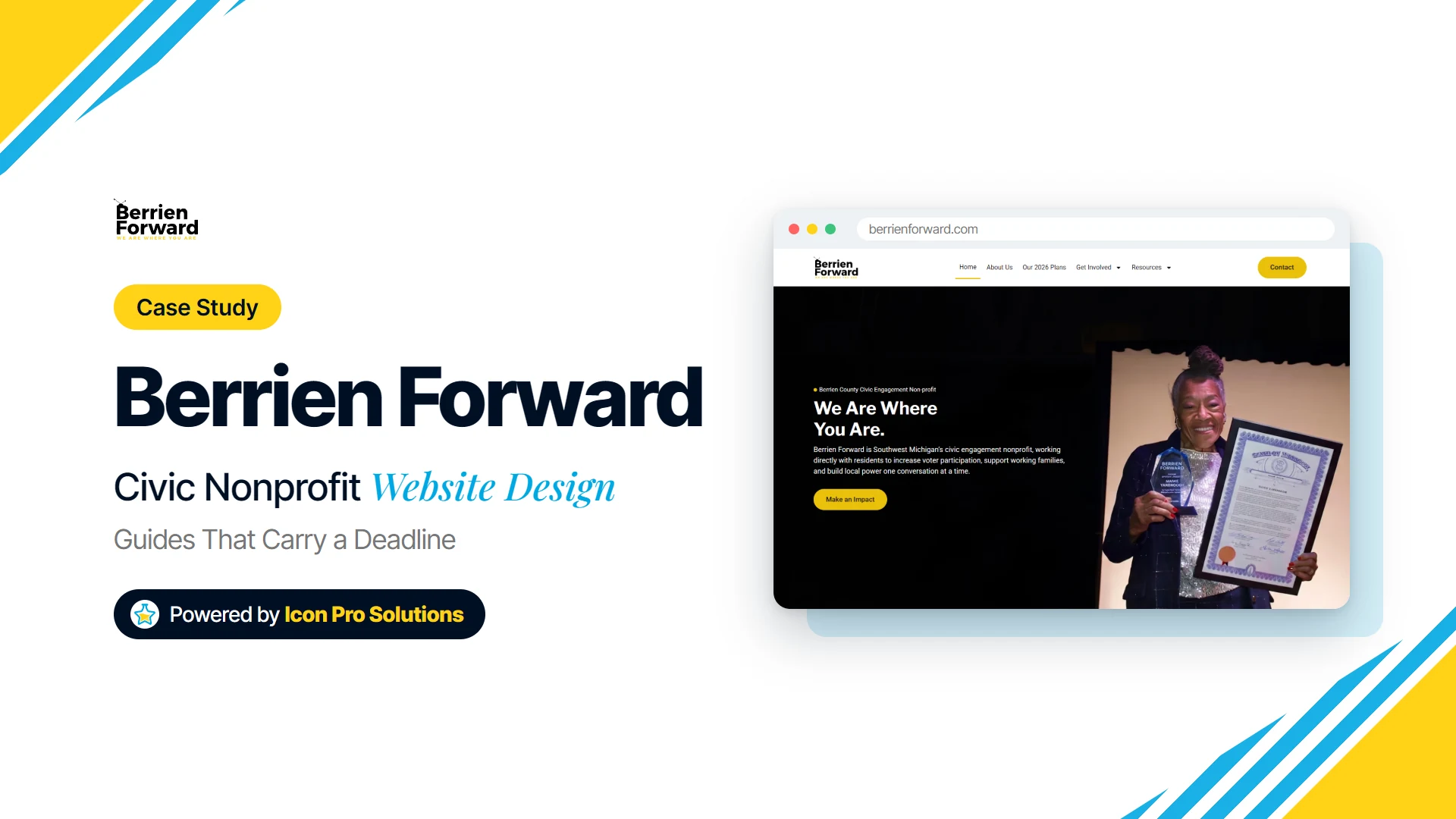
Berrien Forward is a nonpartisan community organization in Berrien County, Michigan, and its website leads with exactly this kind of content. We designed and built the site, and this post uses it to look at what a civic website needs when its most important pages are also the ones most likely to go out of date.
Key Takeaways
- A civic site’s most valuable pages, such as registration steps and deadlines, are also its most perishable, so dates belong on the page where readers can see them.
- Leading the home page with guides rather than an appeal tells a visitor the organization is there to be useful first.
- Clear categories let one site serve a voter with an election question and a worker with a question about their job.
- Volunteering, donating and partnering work better as a second step, placed within reach once the reader has been helped.
- Every dated guide needs an owner and a review date, or the site slowly fills with advice that has expired.
What Does Berrien Forward Do?
Berrien Forward describes itself as a nonpartisan community organization, and its home page offers “clear, nonpartisan guides built for Southwest Michigan families.” Two subjects lead: the voting deadlines for 2026, and how to protect your legal rights in the workplace. You can see the current site at berrienforward.com.
Its published articles include How to Register to Vote in Berrien County, Michigan, Voter Registration Deadlines in Michigan 2026, and Labor Rights for Workers in Southwest Michigan. There are also two guides to civic participation and volunteering in Benton Harbor, where the organization lists its street address. The site also carries a podcast and pages for scholarships, events, careers and donors.
Why Do the Guides Come Before the Ask?
The first thing the home page says is what a reader can learn, not what the organization wants from them. The opening line promises guides, deadlines and workplace rights, and the first button is View Latest Articles. Donating, volunteering and partnering are all on the site, but they wait in the navigation and the footer.
This order matters for a civic group because most of its audience does not arrive as supporters. A resident who searches for how to register to vote in their county wants an answer, and the organization that gives a clear one has earned a hearing. An appeal shown before that answer is asking for trust the site has not yet had the chance to earn.
The trade-off is real. A donation button placed lower down is likely to be pressed less often by the few people who arrived ready to give. For an organization whose credibility depends on being seen as a resource rather than a campaign, that is a cost worth accepting.
How Should a Civic Site Handle Content That Expires?
Put the date where the reader can see it
Every article on the Berrien Forward home page and its Insights page shows a publication date, and the registration guides are dated May 15, 2026. On most blogs a date is decoration. On a page about registration deadlines it is part of the answer, because it tells the reader whether the advice was written for the election they care about.
Name the year in the title
The deadlines guide carries its year in its title: Voter Registration Deadlines in Michigan 2026. That helps a searcher scanning a list of results, since it signals at once whether the page is current. It also creates an obligation, because a title with a year in it starts to look stale the day that year ends.
Separate evergreen guides from dated ones
Not every civic guide expires at the same rate. A guide to labor rights or to getting involved locally can stay accurate for a long time, while a deadlines page may need a fresh version for each election. Writing the two kinds differently, and reviewing them on different schedules, keeps the site honest without forcing a rewrite of everything at once.
Why Group the Articles by Category?
Each Berrien Forward article carries a label: Civic Engagement, Election Information, or Worker Rights and Advocacy. The labels do more than tidy the page. They tell a reader at a glance whether an article answers their question before they have read a word of it.
The categories also reflect two quite different readers. One is a resident thinking about an election, and the other is a worker with a question about wages or conditions on the job. A single undivided stream of posts would bury each of them in the other’s content, while labeled categories let both find their way in from the same home page.
As the archive grows, keeping those categories few and plainly named will matter more than the order of the posts.
Where Do Volunteers, Donors and Partners Fit?
The navigation has a Get Involved section, and the footer lists Volunteer, Donate, Partner, Events and Careers together beneath that heading. There are also separate pages for scholarships, including one titled Civic Leadership Scholarship Program, and for becoming a donor. These are the pages a supporter looks for once they have decided the organization is worth backing.
Grouping them under one heading has a clear benefit. A visitor who is ready to help does not have to guess which of five pages applies to them, because the choices sit side by side. The volunteering and civic participation guides also connect the two halves of the site, since each is useful information and an invitation to take part at the same time.
What Role Does the Podcast Play?
The Podcasts page promises “honest conversations about civic life in Berrien County.” The first episode features Eli Savit in conversation with Chokwe Pitchford about the race for Michigan’s Attorney General. Visitors can leave an email address to be told when a new episode goes live.
A podcast gives a civic organization something a written guide cannot: the voices of people in and around the community. The email sign-up suits it well, because episodes arrive on no fixed schedule and a listener is unlikely to keep checking the page by hand. It also keeps a line open to people who are interested but not yet ready to volunteer or donate.
What We Would Watch
- Expired advice. A deadlines guide that stays live after the deadline can mislead a first-time voter. Each dated page needs a named owner and a date on which it is reviewed, updated or clearly marked as past.
- Borrowed figures. Articles that open with national statistics should keep linking to where those numbers came from. A reader should be able to check a figure, and the organization’s credibility should never rest on one they cannot.
- Legal accuracy. Pages about workplace rights explain the law to people who may act on what they read. They need a visible note of when they were last checked and where to go for advice on a specific situation.
Frequently Asked Questions
What should a civic engagement website put on its home page?
Lead with the information residents are looking for, such as registration steps, deadlines and rights, and keep the latest guides one click away. Ways to volunteer, donate or partner should be easy to find but can come second.
How often should election guides on a website be updated?
At the least, before each registration deadline and again after each election. Any page with a deadline in it should show its publication date and be reviewed on a schedule, not only when someone happens to notice a problem.
Should a nonprofit site keep its guides separate from its fundraising pages?
Keep them distinct but connected. Guides earn trust and the involvement pages let people act on it, so each should link to the other without one crowding out the other.
See More of Our Work
Berrien Forward is one of many sites we have designed and built, and you can browse the others on our work page. If your organization publishes guides that people rely on, our digital content strategy service is where we plan how that kind of content is structured, dated and kept current.