Most asset tracking companies sell a device. ARMOR sells a system: hardware fitted to a machine, a cloud platform that holds the record, and a phone app the field team carries. A buyer has to understand all three before any one of them makes sense, and that buyer already owns an ERP they have no intention of replacing.
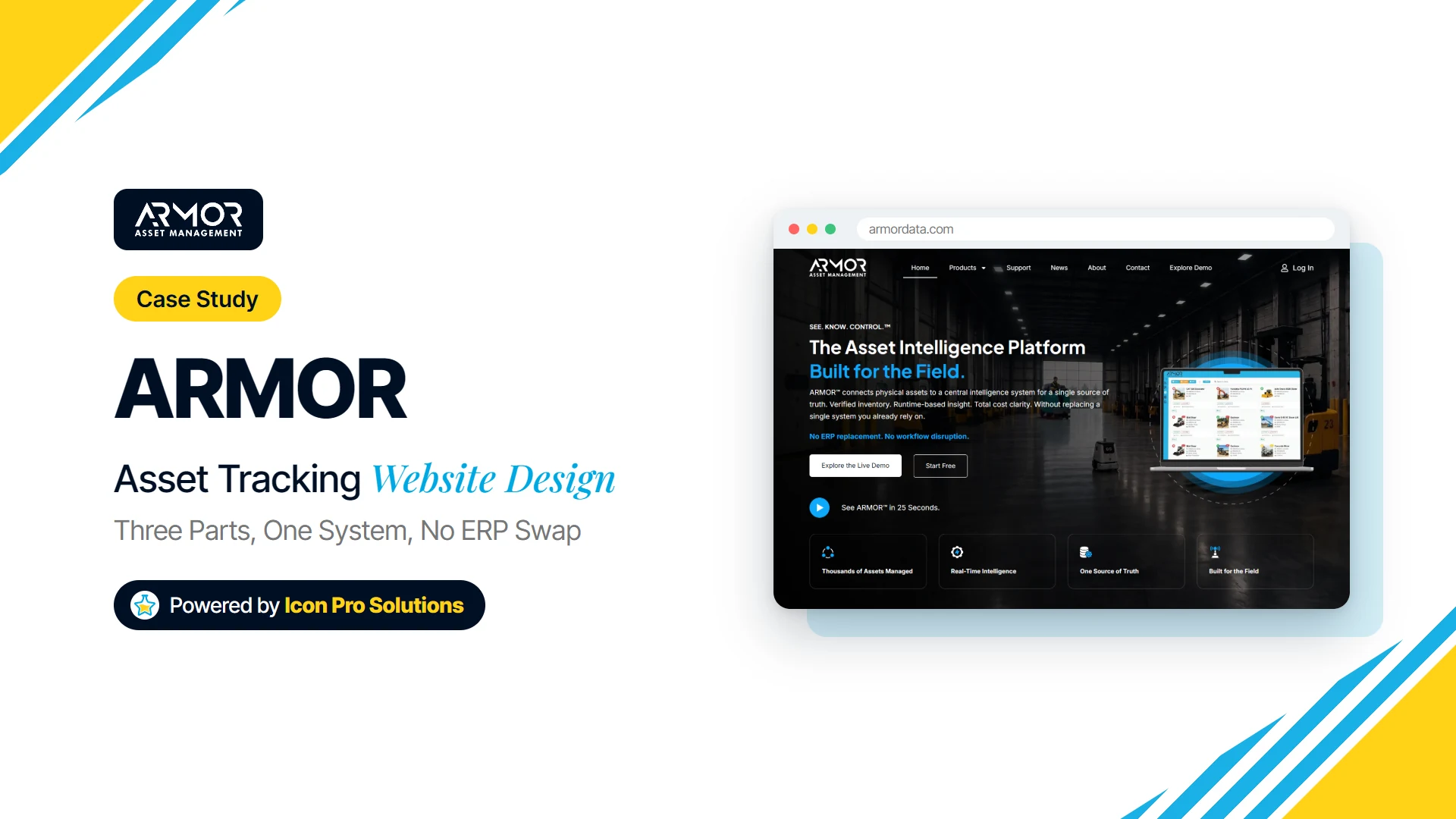
We designed and built the website for ARMOR. This post uses it as a worked example of a problem every connected-hardware company meets online: explaining a multi-part system to an operations buyer while also serving the installer who needs a voltage range and a part number.
Key Takeaways
- When a product works alongside existing software, say so before anything else, because “do we have to replace our ERP?” is the first objection.
- A system with several parts needs a menu that teaches the structure: core platform, extensions, legacy.
- Deep specification pages belong on the marketing site when the person who installs the hardware is part of the decision.
- Every device page should end by pointing to the part that holds the data, so no page reads as a standalone gadget.
- Several doors (a free start, a demo, a routed contact form, login portals) let different readers act without all queuing for sales.
What Does ARMOR Do?
ARMOR describes itself as an asset intelligence platform that acts as the system of record for physical assets. Its core has three parts: ARMOR 4+, a field hardware hub that captures runtime hours and verifies asset identity; ARMOR Asset Central, the cloud platform; and the ARMOR Mobile App, the field interface on iOS and Android. Two extensions, ARMOR Beacon and ARMOR Track, feed the same platform, and older devices are listed as legacy products.
The company traces its origin to a repair shop rather than a boardroom. Its About page says founder Bruce Bushert spent two decades building a floor machine service network and, in 2011, built the small device that became ARMOR. The company gives its home as Decatur, Illinois.
Why Does the Home Page Lead With “No ERP Replacement”?
Because the reader arriving from operations or finance has been sold software before. Their first question about any new platform is what it will cost in migration, retraining and disruption, and until that is answered they will not read about features.
The ARMOR home page answers it directly under the headline, in two short lines that rule out an ERP replacement and any workflow disruption. The FAQ repeats the point with “Does ARMOR replace our ERP or existing systems?” and the About page says ARMOR does not replace an ERP, CMMS or procurement platform.
Repetition like this can look like padding. Here it does a job, because different people raise the objection at different points and any of those pages may be the first one they land on.
How Do You Explain Three Products as One System?
The risk with a multi-part product is that a visitor reads one page, sees one device, and files the company under “tracker”. ARMOR’s own copy says the opposite outright: it “is not a single product,” and every component has a specific role.
The Menu Does the First Explaining
The navigation groups products as Core Platform, Extensions and Legacy Products. Before a visitor opens a single page, the menu has told them there is a center, there are add-ons, and there is an installed base of older hardware. That is information architecture carrying part of the sales argument.
Every Device Page Points Back to Asset Central
The Beacon page closes with “ARMOR Beacon Feeds ARMOR Asset Central,” and the Track page closes the same way. The Asset Central page then describes four steps: capture, sync, verify, act. Each device is written as an input to the platform, which keeps the reader thinking about the system instead of comparing one tracker’s battery life with another’s.
Why Keep Full Spec Sheets on a Marketing Site?
Because in hardware the decision is rarely made by one person. An operations director may approve the budget, but somebody has to confirm the device fits the equipment, and that person wants voltage ranges, enclosure ratings, mounting options and part numbers.
The ARMOR 4+ page carries all of it. It lists a 6 to 90V DC input range, an IP67 enclosure, and adhesive, screw or zip-tie mounting, with certifications including FCC, PTCRB, CE and RoHS. A security section covers AES-256 encryption and monthly external penetration testing.
The wiring harness is described wire by wire, a parts list gives part numbers, and a spec sheet is there to download. The Beacon and Track pages follow the same pattern.
The trade-off is length, and an executive scrolling that page may feel it was written for somebody else. The page is stacked so each reader can stop early: summary badges and a plain description at the top, capabilities in the middle, technical tables below.
Who Is Each Door For?
A system sold to operators, distributors and manufacturers has more than one kind of visitor, and a single “Contact Us” button treats them all as the same lead. ARMOR’s site gives them different ways in.
- A free start. Asset Central can be tried free for up to 100 assets, with no contract and no credit card, starting from a photo in the app.
- A demo. “Explore the Live Demo” and “Book a Platform Walkthrough” serve the buyer who wants to see the product before committing time to a call.
- A routed contact form. The form asks what the inquiry is about, with options that run from a hardware or deployment quote to technical support, partnership, investor relations and press. It says each request is routed to the right team within one business day.
- Portals. The login page separates manufacturers and developers, and legacy product pages point existing users to a support portal.
The legacy pages deserve a note of their own. ARMOR 4, ARMOR 3 and ARMOR 2+ are marked as not available for sale, yet each keeps a full page. For a company whose devices stay fitted to equipment for years, the people who already own them are an audience, and a page they can find for parts and support is part of keeping them.
What We Would Watch
- One source for each spec. Hardware sites often repeat a figure in a summary, a feature list, a table and a data sheet. When a range or a status changes, every copy has to change together, because engineering readers lose trust quickly when two copies differ.
- Legacy status has to be unambiguous. A page for a product that is no longer sold should say so clearly, and any buying or stock message should come off the page when the status changes.
- Claims need an owner. Deployment examples and security statements are exactly what a procurement team checks, so someone at the company should review them on a schedule, not only when a buyer asks.
- Long pages on phones. If technicians open these pages on a job site, the spec tables need to stay readable at phone width without sideways scrolling.
There is no traffic, lead or sales number to report for this site, and this post does not claim one.
Frequently Asked Questions
Should a hardware company publish full specifications on its website?
Usually yes, when the person who installs or approves the device is part of the decision. Put the summary first and the tables lower down, so the same page serves both readers. Keep one source for each spec so the copies cannot drift apart.
How do you stop a multi-part product looking like a single gadget?
Teach the structure in the menu, and end every device page by pointing to the part that holds the data. ARMOR does this with its Core Platform, Extensions and Legacy Products groups, and with its device pages ending at Asset Central.
Should discontinued products keep their pages?
If customers still use them, yes. Mark them clearly as not for sale and point to support and parts, because an existing customer looking for help is still a customer.
See More of Our Work
You can see this project on our ARMOR portfolio page and alongside our other builds in our work. If your product is a system that has to be explained before it can be sold, our web design service is where that conversation starts.