You typed “website development near me” into Google and did not give a city, a country or a budget. You asked a search engine to read your mind, and it cheerfully had a go.
What came back was probably a map of local firms you have never heard of, and a page on a freelancing marketplace listing several hundred strangers. That is a strange pair of answers to one question, and worth understanding before you click.
Key Takeaways
- Google answers “website development near me” for the general area it estimates you are in, so your results are yours alone.
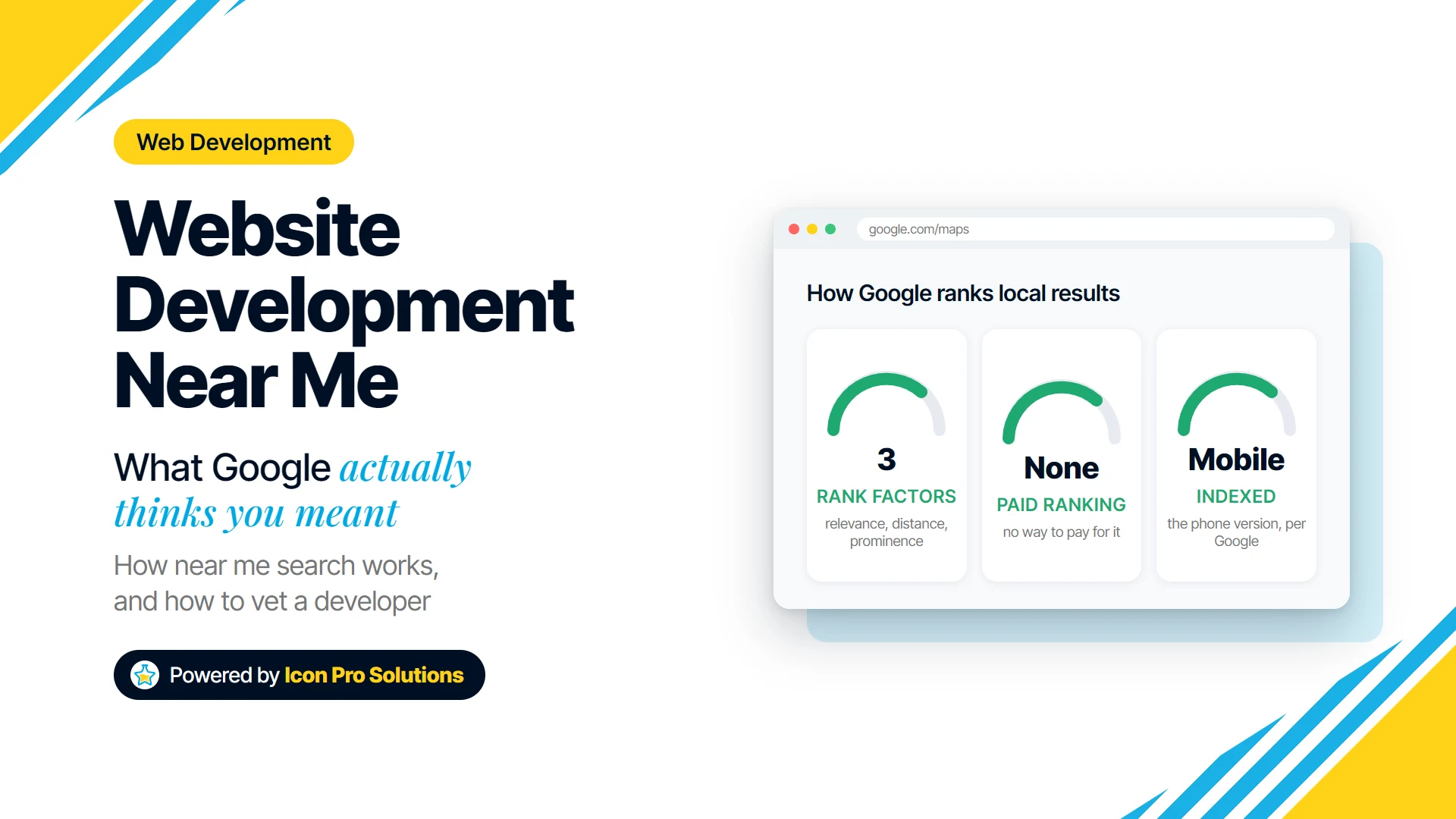
- Google ranks local results on relevance, distance and prominence, and says nobody can pay for a better local ranking.
- Being near you improves accountability and the awkward conversations, not the quality of the code.
- Ten minutes of checks filters most of the field: their site on your phone, live links, ownership in writing, one scope sent to everyone.
- Quotes that differ wildly usually describe different projects wearing the same name.
What does “website development near me” actually mean to Google?
To Google, “website development near me” means website development in the general area it estimates you are searching from. Google Search Help is blunt about it: “When you search on Google, Google will always estimate the general area that you’re searching from.” Sources include your device’s location, if you allowed it, your past activity and your IP address, and Google notes that “IP addresses are roughly based on geography.”
A friend searching the same words in another city sees a different page, so there is no single “near me” ranking to check. The useful part: you are not really searching for a nearby web developer, you are searching for a web developer in your city. So add the city name yourself and stop making Google guess.
Why do a local firm and a freelancing marketplace show up for the same search?
A local firm and a freelancing marketplace appear together because Google is showing two different kinds of answer on one screen: local business listings and ordinary web pages.
The local listings come from Google Business Profiles. According to Google Business Profile Help, “If a customer doesn’t share where they are, Google uses what it knows about their location.” Local ranking rests on relevance, distance and prominence, and the same page adds, with admirable finality, “There’s no way to request or pay for a better local ranking on Google.”
The marketplace page is an ordinary web page, not a company: a filtered list of freelancer profiles that mention your city, some excellent, some never anywhere near you. The local firm shows up because it is local and has said so, in full. Google Business Profile Help puts the whole trick in one line: “Businesses with complete and accurate info are more likely to show up in local search results.”
Does being near matter when you hire a website developer?
Being near matters less for website development than for a plumber, and more than the internet likes to admit. Nobody needs to visit your premises to write CSS, so the best developer for your project might be anywhere. Three things genuinely improve when the team is nearby.
Accountability. A developer whose reputation lives in your business community behaves differently from an anonymous account that can stop replying with no consequences whatsoever. That is the real argument for hiring local, and it has nothing to do with technology.
The awkward conversations. Discovery, scope disputes and the “this is not what I asked for” meeting all go better in a room. Everything else can be email.
Context. Someone local knows what your customers will pay online, whether they pay by card or cash on delivery, and which payment gateways work where you are. That is surprisingly hard to buy remotely.
Notice what is missing: quality of code. Proximity does not make anyone a better engineer, and “close” is not “good”.
What are your four options for website development, honestly described?
Your four realistic options are a marketplace freelancer, a local one-person studio, a local agency and a remote agency, and each fails differently.
- A marketplace freelancer. Cheapest, fastest, highest variance: brilliant people work this way, and so do people who vanish at the eighty percent mark. Payment protection, where the marketplace offers it, protects your money, not your timeline.
- A local one-person studio. Often the best value in the city. Also a single point of failure, with no cover and no succession plan.
- A local agency. More expensive, more process, and someone answers when a person is ill. Worth it if the site matters to your revenue, overkill for a five‑page brochure.
- A remote agency further away. Impressive portfolios, fewer shared working hours. Fine for well-specified work, and painful when the spec changes, which it will.
How do you check any web developer in ten minutes?
You can check any web developer in about ten minutes with six steps and no technical knowledge. You only need to be slightly annoying.
- Open their own website on your phone, on mobile data. Google Search Central explains why the phone version counts: “Google uses the mobile version of a site’s content, crawled with the smartphone agent, for indexing and ranking.” If their own site is slow, broken or unreadable on a phone, you have learned what you need in forty seconds.
- Ask for live links, then open them. Screenshots are free and prove nothing. Ask which parts of each project their team actually built, and watch how specific the answer gets.
- Ask who owns it afterwards. The domain, the hosting, the source code and the analytics: get the answer in writing before you pay. People discover they do not own their website the moment they try to leave.
- Ask what happens after launch. Who fixes a bug in month four, how fast, and at what cost. Ask what they check before go-live, and compare it with a website launch checklist.
- Get the scope in writing. “A website, maybe eight pages” is not a scope, it is a shared daydream. A scope lists pages, features, integrations, who writes the content, revisions and dates.
- Send that same written scope to everyone on your shortlist. One scope sent to every candidate makes the comparison easy, and almost nobody does it.
Why are website development quotes so far apart?
Website development quotes differ wildly because each firm is usually pricing a different project under the same name.
| What moves the price | Cheaper end | Dearer end |
|---|---|---|
| Design | A template | A custom design |
| What the site does | Content pages | Logins and business logic |
| Other systems it talks to | None | Payments, bookings, a CRM |
| Content and photos | You supply them | They write and shoot them |
| After launch | Nothing included | Support agreed in writing |
A cheap quote against a vague scope is not cheap. It is an invoice you have not been shown yet.
Which red flags should end the conversation with a web developer?
Six red flags should end the conversation with a web developer before any money moves.
- A price before a question. If a quote arrives before anyone has asked what your business does, they are not quoting your project.
- The whole fee upfront. Milestones protect both sides, so consider who is unprotected without them.
- No contract, only WhatsApp. Delightful until it is not.
- An “expert team” with no names. Ask who. If nobody can be named, entertain the possibility that there is nobody to name.
- No address, no phone and no people on their own site. A company reluctant to say where it is may have reasons. Google’s Business Profile guidelines state that “If your business rents a physical mailing address but doesn’t operate out of that location, also known as a virtual office, that location isn’t eligible for a Business Profile.”
- A footer listing every city in the region. Google’s spam policies name “Blocks of text that list cities and regions that a web page is trying to rank for” as an example of keyword stuffing. A developer who does that to their own site will happily do it to yours.
What if you are searching from Quetta?
From Quetta, “website development near me” means website development in Quetta, a small market you can check in person. Go and see the offices: in a city this size, visiting a shortlist is a realistic afternoon.
Since you are reading this on our site, here is our position, stated plainly. Icon Pro Solutions has been founder-led since 2012, and our office is in Quetta, where we also teach our diploma and certificate courses in person.
Our portfolio is public, so apply the live-links test to us too. Our process is published as well and starts with a written scope and price, agreed before any work starts, which beats discovering the price together in week six.
If we are not the right fit, we will say so early, and if we are, come and talk to us. Either way, every check here works on everybody else, and we would rather you hired the right team than the closest one.
Frequently Asked Questions
What does “website development near me” actually search for?
“Website development near me” searches for website development in the general area Google estimates you are in, using sources such as your device’s location and your IP address. Adding your city name yourself gives more predictable results.
Should I hire a local web developer or a remote one?
Hire a local web developer for accountability, easier scope conversations and local knowledge of your customers, not for better code. Websites are built remotely, so proximity does not change technical quality.
Do I own my website when it is finished?
You own your website only if the contract says so. Ownership of the source code, the domain, the hosting account and the analytics should be confirmed in writing before the first payment. It is not automatic.
Want the website development done for you?
If your search for website development near me ends with wanting the whole thing handled, our WordPress website design service is the next step. It starts with a written scope of pages, features, content and price, agreed before work starts. We build in Elementor, so your team can edit text, images and pages without a developer, and your domain, hosting and logins are in your name from day one.
If you have developers and only need pages designed, web design covers that alone. For a site of a few pages, building it yourself on a website builder is a reasonable choice.