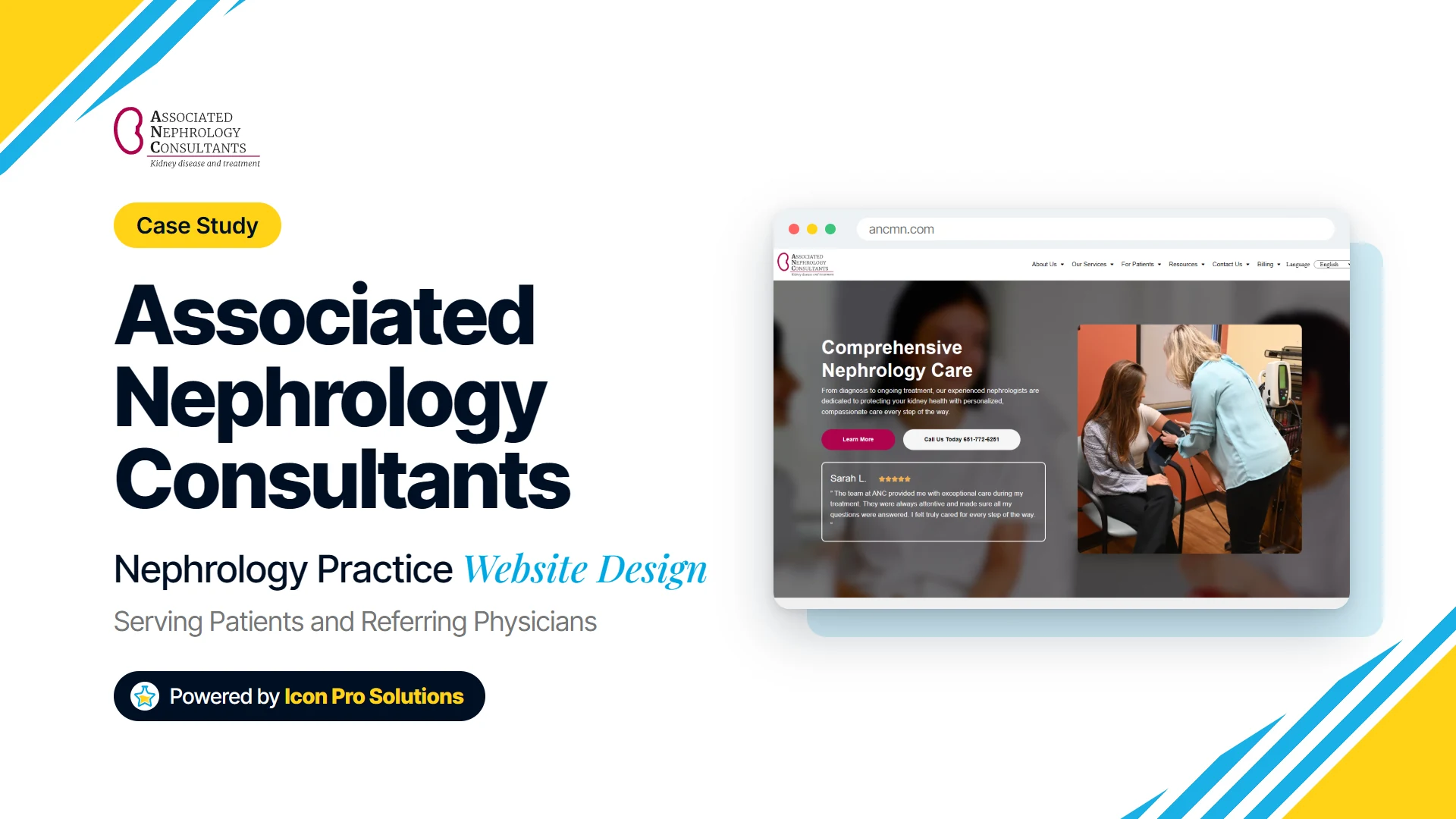
Associated Nephrology Consultants is a kidney care practice in Minnesota, and its website has a problem most clinic sites never face. Kidney patients often reach a nephrologist because another doctor sent them, which means the site has two readers with very different questions: the patient who has just been told to book, and the physician deciding where to refer.
A site that only speaks to patients leaves the referring office guessing about what to send. A site that only speaks to physicians feels cold to someone who has just heard the words “kidney disease” for the first time. The ANC site is built to hold both conversations without letting either one crowd the other out.
Key Takeaways
- Specialist practices often receive patients through referrals, so the referring physician is a primary audience, not an afterthought.
- A referral page is most useful when it lists exactly what to send with the patient, item by item.
- Patients preparing for a first visit want the practical checklist: forms, arrival time and what to bring.
- When care happens in clinics, hospitals and dialysis units, the locations page has to say which kind of care happens where.
- Every date, address and job listing on a clinical site is a promise that needs an owner.
What Does Associated Nephrology Consultants Do?
Associated Nephrology Consultants was founded in St Paul in 1977. The practice says seven physicians and eight nurse practitioners or physician assistants see patients with acute and chronic kidney disease. The conditions it lists include kidney disease related to diabetes and high blood pressure, glomerulonephritis, polycystic kidney disease, kidney stones, anemia related to kidney disease, and patients approaching dialysis, on dialysis, or before and after a transplant.
The main office is in Maplewood, open Monday to Friday. Beyond it, the practice sees patients at outreach clinics in Minnesota and western Wisconsin, cares for inpatients at several hospitals, and works across a long list of dialysis locations. It also runs research into a set of kidney conditions and recruits staff through its own careers page.
Why Does a Nephrology Site Need a Page Written for Other Doctors?
Because the physician who refers a patient is making a decision on that patient’s behalf, and they make it faster when the specialist has already answered their questions. The ANC site gives referring physicians their own partnership page rather than a line at the bottom of the contact form.
What the Referral Page Asks For
The strongest part of that page is a numbered list of what the practice needs from the referring office. It asks for recent notes and problem lists, a complete medication list, several years of creatinine levels, a urinalysis if one is available, and any previous renal imaging. Each item comes with one sentence explaining why it matters.
This is a small design choice, but it shapes the referral itself. A referring office that knows what to send does not have to call to ask, and a nephrologist who receives the right history does not start the first consult by chasing it. The page turns an informal habit between offices into written instructions anyone on the front desk can follow.
What the Referrer Gets Back
The same page describes what the referring physician can expect in return. It says urgent consults can typically be accommodated within a week, describes a CKD Pathways clinic for patients with late-stage kidney disease, and says referrers receive summaries and recommendations promptly. Those are the three things a referring doctor worries about: speed, fit and whether they will hear back.
What Does a Patient Need Before the First Appointment?
A new nephrology patient is often anxious and usually busy with other appointments, so the patient side of the site stays practical. The For Patients page puts four documents first: a registration form, a HIPAA form, a privacy notice and a patient packet. The home page repeats them as a numbered list, so a patient who never opens the menu still finds them.
Below the forms is a short first-visit section. It tells new patients to arrive 15 minutes early to complete paperwork and to bring a list of current medications and dosages, or the bottles themselves, along with insurance cards, photo ID and pharmacy information. None of this is clever, and that is the point: it is the information the front desk would otherwise give on the phone.
The top navigation also gives Billing its own item, and the contact form offers Billing Inquiry as a subject next to General Inquiry. For a practice whose patients may be on long-term treatment, billing questions are routine, and giving them a named path keeps them out of the general inbox.
How Should a Practice Show Care That Happens in Many Places?
A nephrology practice does not work from one building. ANC’s own copy describes a main clinic, satellite clinics, hospital rounds and dialysis units, and a patient needs to know which of those applies to them.
Grouping Locations by the Kind of Care
The locations page does not present one long list of addresses. It groups them as the clinic location, outreach locations, hospital locations marked “In Patients Only”, and dialysis locations, with the dialysis entries grouped again by town. That labelling answers the question a patient actually has, which is less about where the practice is and more about where they should go.
The “In Patients Only” label does quiet but important work. Without it, a patient could reasonably drive to a hospital expecting an outpatient appointment. A location list for a practice like this is part of the care instructions, not decoration.
Introducing the People Behind the Care
The team page is split into tabs for MDs, APPs, MAs, RNs, Management and CCs, and each physician carries the year they joined ANC. For a patient who may see the same practice for years, a joining year says more about continuity than an adjective would. The home page also gives nursing its own section, which is a fair reflection of how much of kidney care happens between physician visits.
What We Would Watch
A site built around lists of places, people and requirements is only as good as the day those lists were last checked. Here is where we would keep an eye on this kind of site.
- Time-bound wording. Phrases such as coming soon or opening next season are true when written and misleading a season later. Any location announced ahead of time needs a date, or a reminder to remove the wording once it opens.
- Address consistency. An address that appears in the body, the footer and a list of care locations has to read the same in every place, down to the city name. Patients and directories both treat two versions of one address as two places.
- Job listings. Every listing should give the role’s real location, because a location outside the practice’s own region confuses applicants. Old listings should come down when the role is filled.
- Referral requirements. The five items requested from referring offices are clinical decisions. If the practice changes what it needs, the page has to change the same week, or referrers will keep sending the old list.
- Team pages. With seven physicians named and several staff roles in tabs, arrivals and departures need to reach the website as quickly as they reach the schedule.
Frequently Asked Questions
Should a specialist practice website have a separate page for referring physicians?
Yes, when referrals bring in a large share of new patients. A separate page lets the practice tell other offices what to send and what they will get back, without burying that detail in patient-facing copy. ANC’s partnership page is a working example.
What belongs on a patient forms page for a medical practice?
The forms themselves, then the practical details of the first visit. ANC lists registration, HIPAA, privacy notice and patient packet, followed by arrival time and what to bring.
How should a practice with many care locations list them?
Group them by the kind of care each place provides, not only by town. Labels such as “In Patients Only” stop patients going to the wrong kind of site.
See More of Our Work
You can see how we presented this project on the Associated Nephrology Consultants portfolio page, and browse other client sites on our work page. If your practice needs a site that serves patients and referrers alike, our UX and UI design service is where that planning starts.