Latif Carpet is a carpet and rug retailer with a showroom and an online shop of Persian classic, vintage, modern vintage and silk rugs. The hard part of putting a rug catalogue online is that shoppers do not agree on where to start: one arrives knowing the room is 8 by 11 feet, another wants something blue, and a third has been told to look for a particular weave.
A single list of products serves none of them well. With 242 pieces in the shop, the navigation has to let each shopper start from the question they already have.
Key Takeaways
- Rug buyers start from different constraints, so a rug catalogue needs several entry points, not one category tree.
- Size is often a hard constraint, which makes Shop By Size one of the most useful menus on the site.
- Specification filters such as reed count help informed buyers and need a plain explanation for everyone else.
- Product names that carry style, collection, size and code make a large catalogue searchable, but only if they are written consistently.
- Low-stock and sale labels are useful only while the stock and price data behind them are accurate.
What Does Latif Carpet Do?
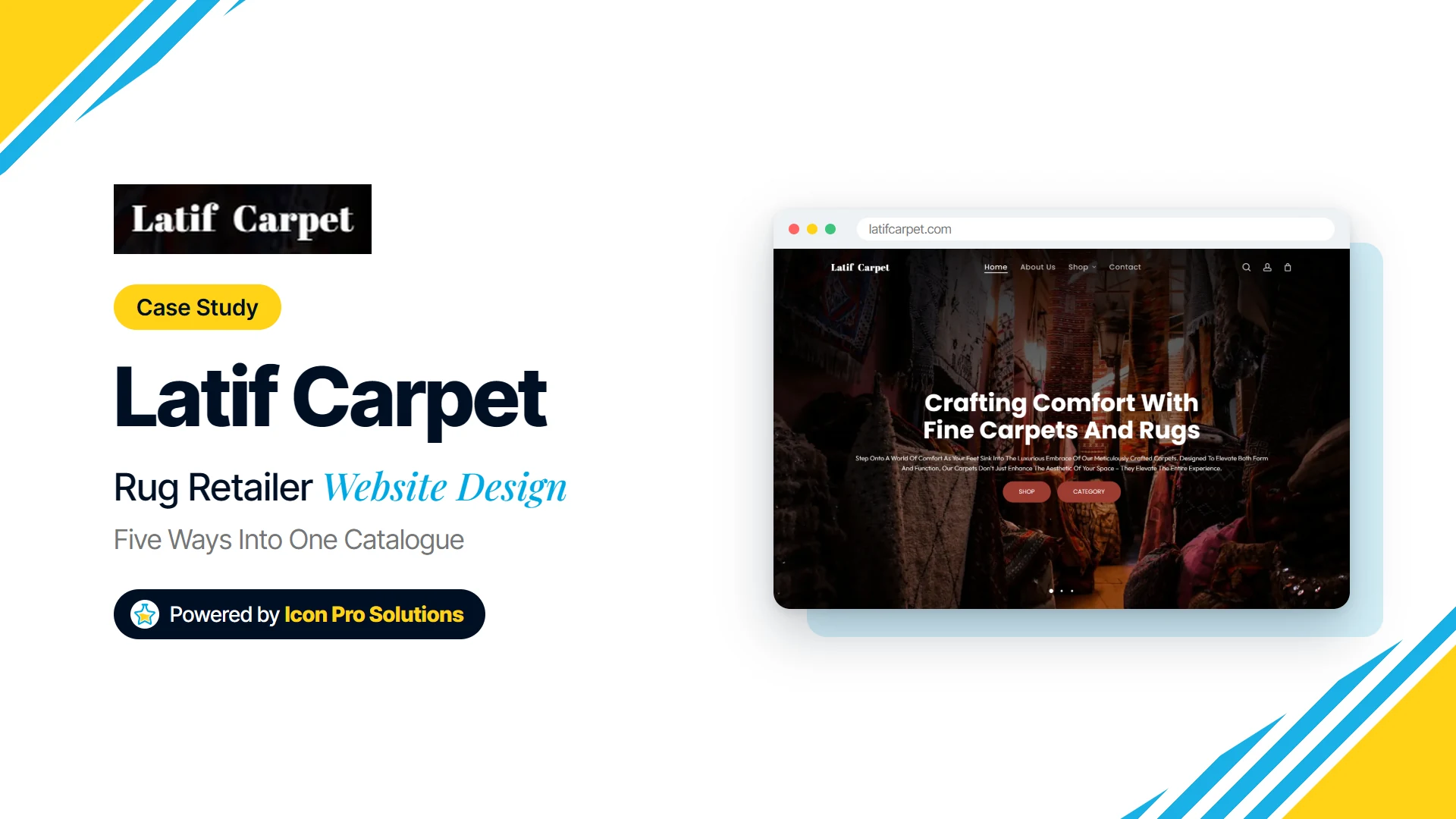
Latif Carpet sells carpets and rugs, describing its range as classic Persian, vintage and modern vintage, semi-handmade and handmade-look designs, and silk pieces, alongside home accents. The home page opens with “Crafting Comfort With Fine Carpets And Rugs” and ends with a Find us on Google Maps link.
The online shop lists 242 products across seven styles, from 138 Persian Classic Premium rugs to 4 runners. We designed and built the website.
Why Does a Rug Catalogue Need Five Ways In?
Because each shopper arrives with a different fixed point. The Shop menu on Latif Carpet is divided into five groups: Shop By Style, Shop By Size, Shop By Reeds, Shop By Colour and Shop By Yarn.
Each group answers a different starting question. Style is for the shopper who knows the look, size for the one who has measured the room, colour for the one matching a sofa, and reeds and yarn for the one comparing quality and material.
Size is the constraint that cannot bend
A shopper can compromise on colour, but a rug that does not fit the floor is the wrong rug. The size menu lists 11 standard sizes, from 3 ft 3 in by 5 ft up to 9 ft 10 in by 16 ft 4 in, so a shopper who has measured can go straight to what fits.
That is also why size belongs in the menu rather than only in a filter. A filter asks the shopper to browse first and narrow later, while the menu lets them start from the measurement.
Style carries the brand
The seven styles are Modern Vintage, Modern Vintage Premium, Persian Classic Premium, Persian Classic Vintage, Persian Classic Vintage Premium, Semi-handmade Persian Silk and Runner. They are how the retailer describes its own range, and they read like the sections of a showroom floor.
How Do You Present a Specification Most Shoppers Do Not Know?
Reed count is the least familiar of the five menus. The shop offers 420, 500, 700, 1000, 1200, 1500 and 1600 reeds, and many product names include the figure, such as 1200 Reeds.
For a buyer who already knows what the figure means, a reed filter is the quickest way to compare quality across styles.
For a buyer who does not, it is a number without a meaning. A specification menu earns its place only with a short explanation nearby, ideally on the category page itself, so the shopper learns the term at the moment they need it.
What Does a Rug Product Card Need to Show?
Enough to decide whether to click. The Latif Carpet cards show the product name, the price, a Sale label with the original and current price where one applies, and a stock message such as “Only 2 left in stock!”.
Products with several variants show Select Options instead of Add To Cart, and a Quick View lets a shopper check details without leaving the list. Sold pieces can stay in the list, marked SOLD OUT.
Names that do the work of a spec sheet
The product names are long on purpose. A Mohtasham Collection listing, for example, names its style (Persian Classic Premium), its construction (handmade-look), its reed count (1200), its surface (embossed design) and its size (10x13ft), which helps both the site search and a shopper scanning a grid.
The names also make an honest distinction. Handmade-look and semi-handmade describe what a piece is, and keeping those words in the name helps stop a buyer assuming a rug is fully handmade.
Where Does the Showroom Fit?
Close to the surface. A rug is a large, tactile purchase, and many buyers want to see the colour in daylight or feel the pile before they pay, so the website works partly as a way to plan a visit.
The home page carries a Find us on Google Maps link, and the footer links to Facebook, Instagram and Messenger. A shopper who has narrowed the catalogue to three rugs online can ask about them, or go and see them, without starting again.
That makes the online catalogue useful even to buyers who will never check out online. The trade-off is that the website and the showroom floor must agree about what is in stock.
What We Would Watch
- Size written several ways. A size can appear in the menu, in a filter and in a product name, and if it is written differently in each place, a filter quietly misses rugs that should match.
- Explaining the reed filter. A reed count filter helps every shopper only when a plain definition sits next to it.
- Handmade wording. Words such as artisan and handcrafted have to match what each product is, especially in a range that also includes handmade-look or semi‑handmade pieces.
- Stock and price labels. Low-stock counts, sale prices and sold-out markers are persuasive only while the numbers behind them are right, so they need the same care as the stock itself.
- One currency, everywhere. Prices should be shown in the same currency on the home page, the shop and the product page, or shoppers stop trusting any of them.
Frequently Asked Questions
What filters does a rug e-commerce site need?
Size, style and colour at minimum, because those are the constraints most shoppers bring. Material and weave density help buyers comparing quality, as long as the site explains what they mean.
Should a rug shop list every size as its own product?
Where the design is the same, one product with size options keeps the catalogue tidy, and the Select Options button handles the choice. One-of-a-kind pieces are different and usually need their own listing.
How do you show handmade and machine-made rugs honestly online?
Put the construction in the product name and the filters, not only in the description. Terms such as handmade-look and semi-handmade tell the buyer what they are getting before they click.
See More of Our Work
You can see how we presented this project on the Latif Carpet portfolio page, and browse other sites we have designed and built in our work. If you are planning an online catalogue of your own, our web design page explains how we approach it.