Most businesses commissioning a website describe what they want it to look like. Very few can say what they want it to do. That gap is why so many sites get rebuilt within two years: the first one was judged on whether the owner liked it, and nobody agreed in advance what it was supposed to achieve.
This covers what actually happens in a web design and development project, what decisions you will be asked to make, and how to tell whether a site is working once it is live.
Key Takeaways
- Define one primary action for the site before any design work starts. A site that tries to do five things does none of them well.
- Design and development are different disciplines with different failure modes. A beautiful site that loads slowly fails commercially.
- Content is almost always the bottleneck. Projects stall waiting for copy and photographs far more often than for code.
- Judge a live site on whether people complete the action you built it for, not on whether traffic went up.
What Is the Difference Between Web Design and Web Development?
Design decides what the site looks like and how it is used: structure, layout, typography, imagery, and the path a visitor takes from arriving to acting.
Development makes it work: turning the design into a real site, making it fast, making it behave on a phone, connecting forms and payments, and making it something you can update without a developer.
They fail differently, which is why both matter. A poorly designed site confuses visitors. A poorly developed site loses them before it loads. The second failure is invisible in a design review, because the design looks fine in the presentation.
What Should You Decide Before Any Design Starts?
One primary action
Not five. One.
Every website has something it most wants a visitor to do: request a quote, book a call, buy, apply, subscribe. Everything else is secondary. Deciding this first changes the homepage, the navigation, and what goes above the fold.
Sites that never make this decision end up with a homepage carrying six competing calls to action and a visitor who picks none of them.
Who the visitor actually is
Not a demographic. A situation. Somebody comparing three suppliers at eleven at night on a phone is a different design problem from a returning customer looking for a phone number.
The useful exercise is listing the three most common reasons someone arrives, then checking that each has an obvious path from the homepage.
What content actually exists
This is the single most common cause of delay, and it is worth being blunt about it before a project starts.
Designs need real content. Real copy, real photographs, real product information. If those do not exist, someone has to make them, and that someone is usually you. A project scoped as “six weeks to build” becomes a five-month project because nobody allowed time for writing the about page.
Decide early who is writing the copy and who is supplying images, and put dates on both.
How Does a Web Project Actually Run?
Broadly four stages, whatever they are called:
- Discovery. What the site is for, who uses it, what pages exist, what happens on each. This is where scope is set, and where problems are cheapest to fix.
- Design. Structure first, then look. Expect to review key pages rather than every page: most sites use a handful of layouts repeated.
- Build. The design becomes a working site, with the content management set up so you can edit it afterwards.
- Launch and after. Testing, migration, redirects from old URLs, and then the part most projects skip: watching what happens and fixing what does not work.
The stage people most often want to skip is discovery, because it produces documents rather than visible progress. It is also the stage that determines whether the rest goes well.
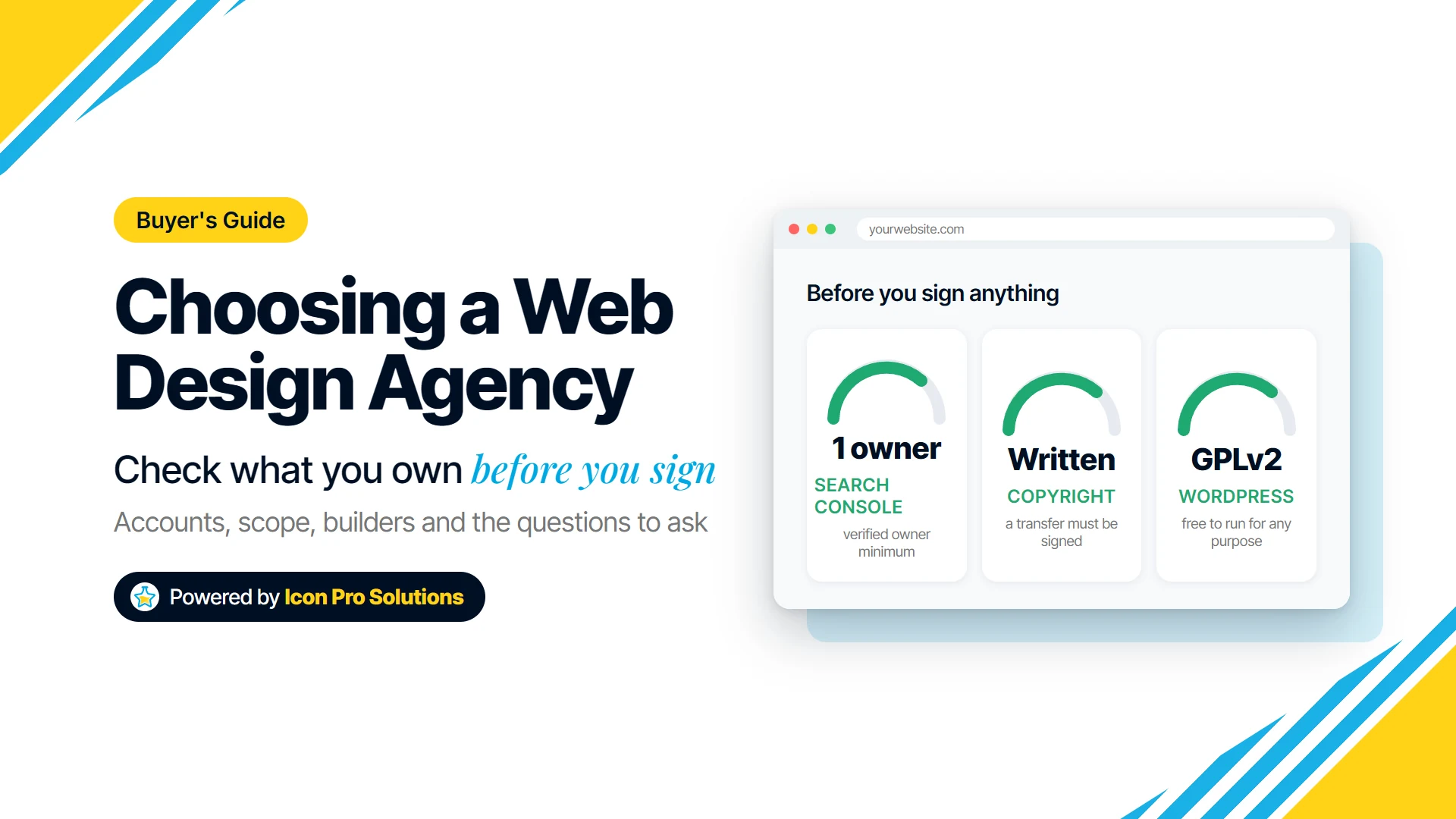
Replacing an existing site? Map the URLs
If you already have a site with traffic, the single most damaging mistake in a redesign is changing addresses without redirecting them. Every old URL should either keep its address or point to the closest genuine equivalent.
Sites lose hard-won search visibility this way regularly, and it is entirely avoidable. If you are replacing a site that ranks, ask any prospective supplier how they handle the URL map, and treat a vague answer as a serious warning. This is core to how we approach a redesign or rescue.
What Makes a Site Work Commercially?
Speed, especially on a phone
Most visitors arrive on a mobile connection. A site that takes several seconds loses a meaningful share of them before they see anything, and they never appear in any report as a lost customer because they were never recorded as a visitor.
Speed is mostly decided by choices made during the build: image handling, how much is loaded up front, how many third-party scripts are added. It is much cheaper to build fast than to optimise later.
Clarity above the fold
A visitor should be able to answer “what is this and is it for me” without scrolling. That is a copy decision more than a design one, and it is where vague positioning does the most damage.
Proof near the action
Testimonials, named clients, completed work and credentials belong next to the thing you want someone to do, not on a separate page they will never visit.
Something you can actually update
A site you cannot edit becomes stale, and stale is worse than plain. Before you sign off, ask to be shown how you would change a paragraph and add a page. If that requires a developer, it will not happen.
How Do You Know If It Worked?
Not by traffic alone. Traffic can rise while enquiries fall, usually because the visitors are the wrong ones.
Judge it on the primary action you defined at the start: how many people complete it, and whether the enquiries you receive are better qualified. A site that halves your enquiries and doubles the proportion worth quoting is a success, and a traffic report will describe it as a failure.
Give it time and be honest about attribution. A new site does not change a market, and a seasonal business will produce a misleading month-one comparison.
Frequently Asked Questions
How long does a website take to build?
It depends on page count, how much is custom, and above all how ready the content is. The variable that most often extends a timeline is not development, it is waiting for copy and images.
Do I need a custom design or will a template do?
A template is a reasonable choice when the site is straightforward and speed matters more than distinctiveness. Custom design earns its place when the offer needs explaining, the market is crowded, or the site has to do something specific that templates assume you do not need.
Who should write the website copy?
Somebody who understands the business, with editing help. Copy written entirely by an agency without deep input tends to be fluent and generic; copy written entirely in-house tends to be accurate and unstructured. The best results are usually a collaboration.
What happens to my search rankings when I redesign?
They are at risk mainly from URL changes rather than from design. If every old address either survives or redirects to a genuine equivalent, a redesign does not have to cost visibility.
Should the site be built so I can edit it myself?
In almost all cases yes. The alternative is a site that stops changing the moment the project ends. Ask to be shown the editing process before sign-off, not described it.
Planning a Website?
If you are about to commission or replace a site, the most valuable hour is the one spent deciding what it is for, before anyone opens a design tool.
See our named work in the portfolio, look at web design and WordPress builds, read our process, or get in touch.